Declare
Author templates, palettes, modifiers, and compositions as portable JSON documents.
 Mosvera
Canonical Mosvera public aesthetic
Mosvera turns named aesthetic intent into portable packs, local registries, design tokens, CSS variables, and provider payloads without a hosted runtime dependency.
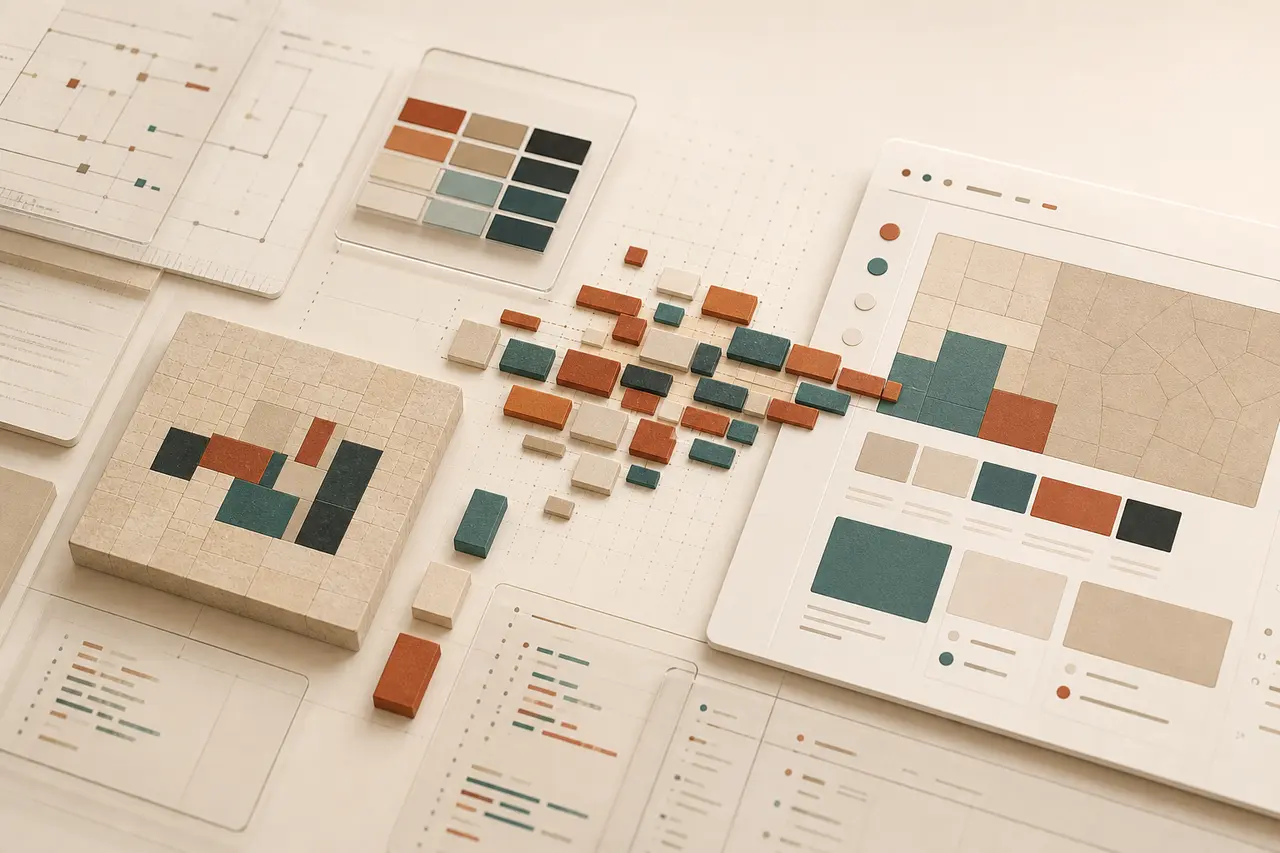
Author templates, palettes, modifiers, and compositions as portable JSON documents.
Fold inheritance and modifiers into a canonical aesthetic model with explicit precedence.
Lower that model into your platform: site tokens, design systems, prompts, and provider payloads.
What is Mosvera?
Mosvera gives AI-native products a shared way to describe, exchange, resolve, and compile aesthetic direction. Teams keep named aesthetics in local registries, share them as `.mosvera.json` packs, and compile them into design tokens, CSS variables, MCP tool results, or provider-specific payloads.
The public contract lives in schemas, compliance vectors, terminology, and implementation guides.
github.com/mosvera/specUse the TypeScript runtime, Python runtime, or local MCP server inside your own tools.
@mosvera/runtime on npmDownload public packs, preview imports, and bring named aesthetics into a user-owned registry.
mosvera/examples packs10-minute quickstart
Install the Claude bundle first, list the seeded aesthetics, preview and import a pack, then try the same resolve/compile flow through npm/MCP, TypeScript, and Python. AI agents can start with the LLM-readable index or the install router.
Package map
Load a local registry, resolve named aesthetics, and produce tokens inside a JavaScript or TypeScript app.
Use the same runtime contract from Python with the PyPI package.
Compile resolved intent into provider payloads for image, video, audio, and 3D providers including OpenAI, FLUX, SDXL, Google, Runway, ElevenLabs, Firefly, and Meshy.
Run a local Claude Desktop-friendly MCP server that lists, resolves, saves, exports, and imports aesthetics from your registry.
Share a named aesthetic as a portable pack that carries registry documents, not secrets or hosted runtime state.
Read schemas, conformance vectors, MEPs, and implementation guidance.
Aesthetic packs
Each `.mosvera.json` pack carries a named aesthetic as portable registry documents. The site defaults to the canonical Mosvera public aesthetic, and every tile can be previewed here before you download, import, resolve, or compile it with Mosvera.
Claude Desktop prompt
Use Mosvera to preview importing this aesthetic pack: /path/to/claymation-playful-builder.mosvera.json
Use Mosvera to import this aesthetic pack into my local registry.
Use Mosvera to resolve claymation-playful-builder and compile it into CSS variables.
What just happened?
Mosvera did not ask your site or agent to depend on a hosted runtime. It used portable files and local tools to turn a named aesthetic into outputs your own platform can consume.
A user-owned folder where Mosvera stores templates, palettes, modifiers, composition documents, and merge rules.
The friendly id you ask for, like claymation-playful-builder.
The technical document that points to a base template, optional modifiers, and overrides.
The portable pack exchange file used to preview, import, and export a named aesthetic.
The compiled output a website, app, agent, or design system can apply.
mosvera.io hosts docs, schemas, and examples. Production usage runs inside your own tools.
Reference demonstrator
The selected composition is pre-resolved for this static v1. A small site adapter compiles the canonical model into CSS variables, so the page changes without pretending that production users depend on this domain at runtime.
Agents use Mosvera the same way: the MCP server runs locally, reads and writes a user-owned registry, imports and exports aesthetic packs, and never sends provider requests by itself.
npm install @mosvera/runtime
pip install mosvera
npm install -g @mosvera/mcp
curl -O https://mosvera.io/packs/claymation-playful-builder.mosvera.json